metasurface-archive

Design in a small town part 3


Sometimes good design has a lot to do with restraint. The coffee shop above is a popular hangout and one of about 200 of the same franchise in our meager little town. The interior has beautiful walls of exposed brick that, during renovation, revealed 80 year old (or so) painted signage and, I guess, graffiti.

I assume the shop owners were worried that the facade wasn't fitting the feeling of the rest of the place. So, they took it upon themselves to add trompe l'oeil faux brick, windows and a handpainted sign. Although hard to see unless you are walking on the other side of the street, all of this is really overkill that does more to destroy the coherent design dialogue between the shop's established identity system and interior design.

Sometimes good design means whispering instead of yelling or, more to the point, knowing when to stop designing!
gregory turner-rahman
metasurface hiatus
I am currently sitting in an airport waiting for my plane to Seattle. I will not be posting as often as I would like (if at all). Hang in there and stay out of trouble.
gregory turner-rahman
Podcasting Television?
In informal discussions with students in my large lecture classes (~350 students) I have been surprised by how many students claim that they DON'T watch television.

Many claim that they have maybe 1 or 2 shows that they may record or watch but the truth of the matter is that DVDs, the internet and video games (even music) have taken chunks of time away from the tube.

It is really interesting how students take little bits of media and, more often than not, literally take it with them.

Although there are a plethora of portable media players (see gizmodo.com), the technology still hasn't hit mainstream.

At the risk of venturing into popular techno-fetishism, I think in the next year or two as the technology becomes widely accepted (in rural areas too) we are going to need to continue the project to reconceptualize graphic and interface design.

The media and the technology that support them, I posit, often promote quick and lasting changes that we (as lowly human beings too concerned with the mundane aspects of our lives) are unable to appreciate until it is practically too late. To quickly jump on hte bandwagon smacks of careless abandon and, in the case of education, pandering popular deterministic mythologies. What's a young educator to do?
gregory turner-rahman
The Visionary Imagination


(thanks to idfueland the nameless bloke who originally posted the image on Flikr)

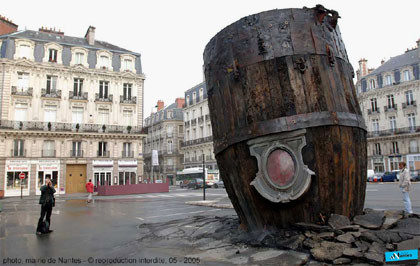
Designers and artists often live in two worlds at once: the imaginary and the real world. Sometimes it is difficult for us to envision what the artist is showing us and other times it is simply magical. In good visionary projects we instantly get it and, for a moment, peer into another world. The object depicted above was created by French theater/puppeteer troupe Royal De Luxeto to celebrate the 100th anniversity of Jules Verne's death. This was one of a number of projects in Nantes, Verne's hometown.

With the ability to translate and share the imaginary comes a lot of responsibility. Ironically, Verne's last book Paris in the 20th Century has pretty much come to be. Maybe if he'd been responsible enough NOT TO DIE and had finished the sodding book and published it we wouldn't be in this mess!

(Yikes! Sorry for that outburst. I am going back to my tut heads...)
gregory turner-rahman
Slacker Guilt: Fun Post Freebie
I got so caught up in my own angst-ridden writer's block last Friday that I forgot to post. So here is what I would've posted:

A couple of weeks ago the NY Times ran an article about a visual reconstruction of the dashing young King Tut. Here's an image from National Geographic magazine:


Like any good educator I thought to myself: "How can I use this image to teach deep and meaningful things about our visual culture and our ability to see the (formerly) invisible?!"

Then I thought to myself: "Screw that! I just want to draw some funky hair on that guy!"

So, if you have Photoshop, go to this site and download some funky hair brushes, install them, and have at it.

Here is my latest creation:


Note: For those of you who perhaps noticed a similarity between the boy king's and my own profile all I can offer is this.
gregory turner-rahman
The Line King


During my lunch breaks these past few days I've been viewing The Line King . It's a quiet and unpretentious documentary about New York cartoonist Al Hirschfeld who passed away in 2003.

The documentary traces his life throughout the 20th century and, while I have been a fan for as long as I can remember, I hadn't stopped to think about what his signature style has come to mean. Basically, he IS New York City in the 20th Century.

Renowned for his caricatures of theater personalities and performing artists in general, Hirschfeld had the fortune of being in the thick of it throughout his entire life. If you want to find the essence of the magical impression that many have of New York, take the time to explore the body of his work. The DVD is a perfect way to do this.

Included in the bonus features is a segment where he draws Paul Newman. Hirschfeld is 99 years old and while much of his markmaking is scratchy he occasionally pulls off a sweeping line that is so elegant. I suppose it is like travelling in Manhattan and seeing the dirt, grime, and rats only to turn the corner to catch a glimpse of the Chrysler building.
gregory turner-rahman
Teaching Future Deep Throats
Now that the identity of Woodward and Bernstein’s infamous informant, Deep Throat, has been revealed it is safe to inform the world that Mark Felt is indeed a former University of Idaho graduate.

Felt graduated in 1935. If there was any question about his role in bringing down Nixon, here is a picture from his senior yearbook:
gregory turner-rahman
Design in a small town part 2


I have to admit that, while I am frustrated at metrocentrism in general, I find myself practicing it often. I get frustrated by the lack of thought that not only goes into the city planning but also the design of little displays, public spaces, signage, and other artifacts which make up the backdrop of our lives.

Take, for instance, the image above. This wine bar is actually quite nice and popular gathering place. Housed in an old Post Office building there is a certain charm to it, I suppose. But the signage is so awful. To add insult to injury, the recent addition of the reader board does nothing to remedy the overall design. It makes me cringe and laugh at the same time when I have to pass it on my way to work.

Did the owners not think that a reader board has come to signify something quite different from the atmosphere of a wine bar!?!

At the same time, the tackiness becomes part of the, well, mystique of small towns. The town appears, for a lack of a better word, authentic. Cities often, on fresh visit, appear to be confused conglomerations of the hyperdesigned and the utter corroded
gregory turner-rahman
Design in a small town part 1
Years ago I left Seattle to live with my wife in a small town in eastern Washington. My friends thought I was crazy for moving back to the town that I had seemingly spent 18 or so years trying to escape. My designer friends expressed the viewpoint that I was removing myself from a viable design scene and thus committing career suicide.

In many ways they were right. Regardless, I am amused by the metrocentrism of my peers. I think that it not only needs to change but WILL change in the next 10 years.

My research of creative communities leads me to believe that as designers (of all sorts) seek to settle down more that they will explore the option of moving to the 'boonies'. I believe that the fear many have of small towns often stems from the various traumas of youth, general impressions of rural america, and their desire to be near many potential clients.

Or it could just be that small towns are, well, tacky. Others have recently discovered strange design artifacts from small towns.

More later...
gregory turner-rahman
The Political Flash
Flash movies are more often than not an annoyance that pertains little to the meat and matter of a website.

But I keep coming across efforts to use Flash as a method of storytelling in the service of imparting complex information or sharing political viewpoints. Many of these Flash movies suffer the same problems as their splash counterparts.

I recently found an informative Flash animation from MoveOn.org. I am uncertain whether the chosen media diminishes (somewhat) the value of the message. Check it out: Bush in 30 Years
gregory turner-rahman
The Invisible Art
I stumbled across The Invisible Art a few weeks ago. The book outlines a comprehensive history of matte painting in film. Matte painting is a hyperrealistic painting of a environment or object that is composited into a motion picture image to provide additional or fantastic sceneographic design (see wikipedia ). The matte painting work is so skillfully done that it is seamlessly integrated into the film.

The book is a bit of a dry read unless you are really into filmmaking or production design but it is interesting to flip through in order to trace the history and, most importantly perhaps, see examples from well-known scenes in a number of films that leave you going: "That was a painting?"

With digital technologies we take this skill for granted. I wonder if these painters worry about their careers in the same way that poster artists do?
gregory turner-rahman
Welcome!
Metasurface will hopefully provide a novel view of the warp and weft of contemporary visual culture.

I am hoping that, in the least, it can be more than a monologue. I would like to explore a host of issues - not just those pertaining to visual culture and communication - such as creative communities (the emphasis of my research), design culture, design education, art and design in rural America, teaching in higher education and host of corollary topics.

Please join me and help me achieve my lofty goals.